
Echoes Across Server Farms: How Data Center Latency Shapes In-Play Adjustments During Global Esports Tournaments
Global esports tournaments rely on distributed server infrastructure that spans continents, where even minor delays in data transmission can force organizers to implement immediate rule changes or technical interventions during live matches. Data center latency emerges as a critical factor because packets traveling between player clients and central game servers encounter variable routing paths, congestion points, and physical distance constraints that differ sharply between venues in Seoul, Los Angeles, and Frankfurt.
Core Mechanics of Latency in Tournament Environments
Latency in these settings measures the round-trip time for game state updates, input commands, and synchronization signals between distributed nodes. Professional platforms maintain dedicated server clusters optimized for sub-20 millisecond response windows, yet cross-region events introduce additional hops through peering exchanges and undersea cable routes that push averages higher during peak hours. Organizers monitor these metrics continuously through telemetry dashboards that aggregate ping data from all participating stations, allowing technical teams to detect spikes before they disrupt competitive integrity.
Studies conducted by network research groups at institutions such as the National University of Singapore have documented how routing inefficiencies between Asian and European data centers create asymmetric delay patterns, particularly when tournaments schedule simultaneous matches across multiple time zones. These patterns become pronounced during large-scale events where viewer streams and player connections compete for bandwidth on shared backbone infrastructure.
Real-Time Detection and Response Protocols
Tournament officials deploy automated monitoring systems that flag latency thresholds exceeding predefined tolerances, triggering predefined adjustment sequences without halting play. Common interventions include temporary region locking that routes traffic through alternate data centers, dynamic adjustment of tick rates to compensate for inconsistent packet delivery, or brief pauses that allow server resynchronization across clusters. Such measures preserve fairness when one team experiences noticeably higher delay than opponents due to geographic placement relative to the primary game server.
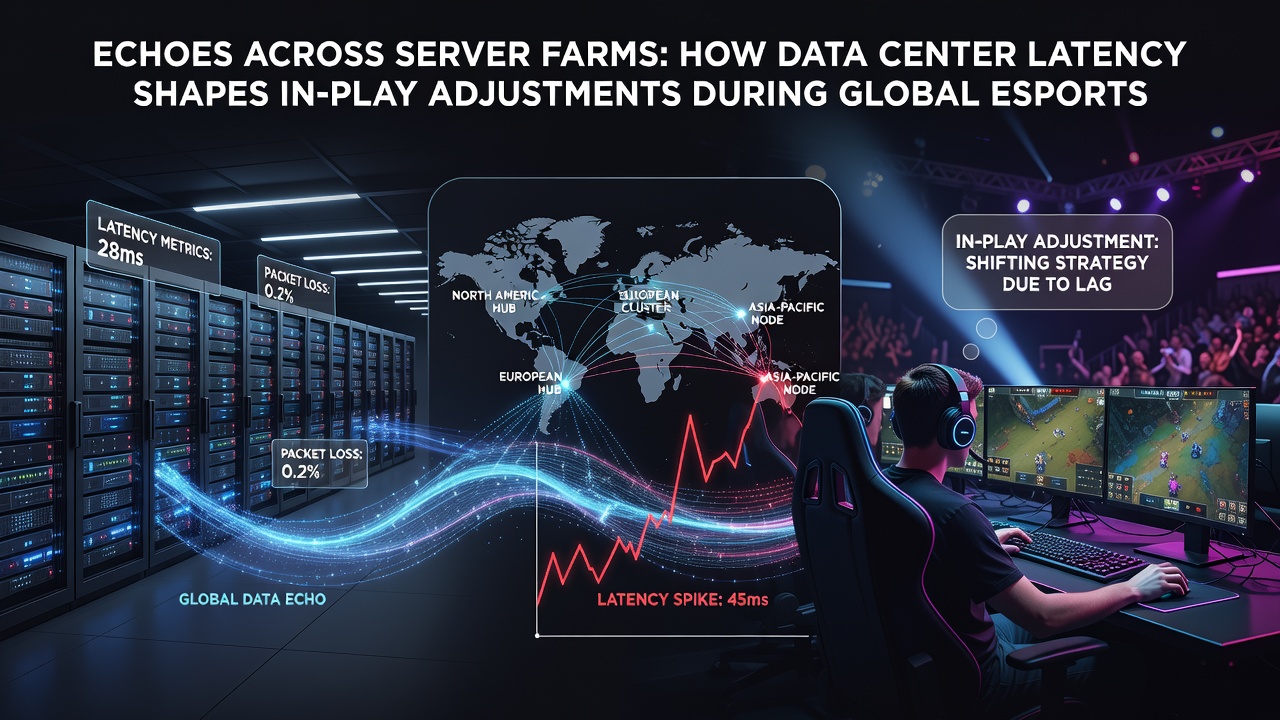
During the June 2026 edition of a major international circuit, analysts observed repeated latency fluctuations between North American and Southeast Asian server farms that prompted mid-series configuration shifts, including reduced simulation fidelity on certain physics calculations to maintain consistent frame timing across clients. These adjustments occurred within seconds of detection and remained invisible to spectators while directly influencing how characters interacted with in-game environments under constrained network conditions.
Geographic Distribution and Infrastructure Variables
Data centers supporting esports events cluster around major internet exchange points, yet tournaments must balance proximity to player bases against the need for centralized authority over match logic. Facilities located in Singapore and Frankfurt frequently serve as primary hubs for Asian and European legs respectively, while secondary nodes in Dallas or Tokyo handle overflow during qualification stages. Physical cable routes, local power grid stability, and peering agreements between carriers all contribute to baseline latency profiles that organizers map weeks in advance.
Research from the Technical University of Denmark has highlighted correlations between undersea cable maintenance windows and measurable increases in jitter during live events, prompting contingency plans that shift traffic to satellite links or secondary fiber paths when primary routes degrade. Tournament software incorporates these variables into pre-match calibration routines that test each participant’s connection under simulated load conditions before official start times.
Impact on Competitive Decision-Making
Coaching staffs and in-game leaders receive latency telemetry overlays that inform strategic calls, such as favoring shorter engagement ranges or simplified ability combinations when delay metrics rise above normal operating ranges. Game developers supply official tools that normalize certain timing windows across regions, yet residual differences persist and require on-the-fly rule interpretations by referees who consult centralized dashboards before issuing final rulings on disputed actions.
League operators publish post-event technical reports that detail every latency-related adjustment, providing transparency while establishing precedents for future circuits. These reports reference aggregated data sets that track millions of individual packet exchanges per tournament day, revealing patterns tied to specific times of day, weather events affecting ground stations, and concurrent large-scale software updates from unrelated services sharing the same infrastructure.
Conclusion
Server farm latency continues to shape operational protocols at every level of global esports competition because physical and network realities impose hard limits on instantaneous synchronization. Organizers respond with layered monitoring, adaptive routing, and calibrated rule modifications that maintain competitive standards even when data echoes travel thousands of kilometers between match participants and authoritative servers. As infrastructure expands and new peering arrangements emerge, the same fundamental challenge persists: translating raw transmission delays into consistent, fair play conditions across increasingly dispersed tournament footprints.