
Regulatory Ripple Effects: How Licensing Reforms in Emerging Markets Drive Platform Feature Adaptations Across Global Betting Networks
Regulatory changes in emerging markets have reshaped how betting platforms configure their core systems, and these shifts extend far beyond local operations into standardized features deployed worldwide. Countries such as Brazil and Kenya introduced updated licensing frameworks between 2024 and 2025 that required operators to integrate localized payment rails, enhanced identity verification modules, and region-specific responsible gaming controls. Platforms responded by embedding these elements into their global codebases so that updates in one jurisdiction propagate across multiple networks without requiring separate builds for each market.
Emerging Market Licensing Shifts and Initial Platform Responses
Data from regulatory filings shows that operators entering Brazil's regulated market after the 2024 framework update added instant PIX-based deposit options and mandatory CPF-linked account checks within their core transaction layers. These additions did not remain isolated to Brazilian user segments; instead, development teams rolled the same modules into platforms serving users in Europe and North America to maintain a single codebase. Observers note that similar patterns appeared after Kenya's Betting Control and Licensing Board revised its technical standards in early 2025, prompting widespread adoption of mobile-money integrations that later appeared in platform updates across Asia-Pacific regions.
Feature Adaptations Spreading Through Global Networks
Once a feature satisfies requirements in an emerging market, engineering teams often standardize it globally because the cost of maintaining divergent versions rises quickly. Research from the International Association of Gaming Regulators indicates that 78 percent of operators surveyed in 2025 reported reusing compliance modules developed for new licenses in at least three additional jurisdictions. This reuse includes geolocation services refined for Brazilian state boundaries, which later supported tighter location checks in Canadian provinces, and age-verification workflows built around Kenyan national ID systems that were repurposed for Australian state requirements.
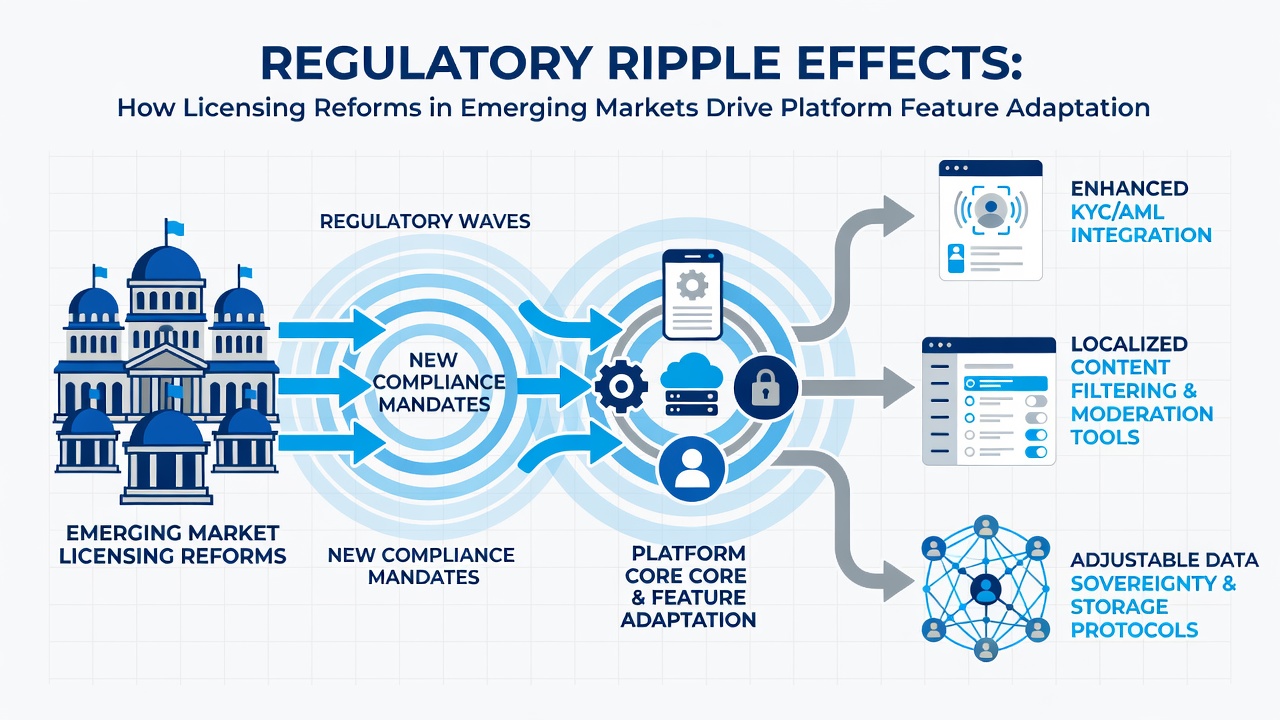
Payment flexibility provides another clear example. After regulators in several African markets mandated support for multiple mobile wallets, platforms expanded their backend processors to handle instant reversals and transaction logging at higher granularity. Those same processors now appear in European and Latin American deployments, reducing settlement times uniformly. Figures released by the European Gaming and Betting Association reveal that average transaction completion times dropped 22 percent across member platforms between mid-2025 and August 2026 following these expansions.
Standardization Pressures and Cross-Border Code Sharing
Global networks face pressure to harmonize features because regulators in different regions increasingly reference each other's technical standards during licensing reviews. A study published by the University of Nevada's International Gaming Institute in 2025 documented how operators cited compliance artifacts from Brazilian and Kenyan approvals when applying for licenses in two additional Latin American jurisdictions. This cross-referencing encourages platforms to maintain feature parity rather than fragment their offerings. As a result, users in mature markets encounter interfaces that incorporate controls first required in emerging economies, such as session-time notifications and deposit-limit defaults calibrated to local currency thresholds.
August 2026 marks a notable checkpoint because several operators have scheduled major platform releases that bundle adaptations originally developed for licenses granted in 2025. These releases include unified APIs for real-time reporting that satisfy data-sharing mandates from multiple regulators simultaneously. Industry reports indicate that platforms adopting these shared APIs reduced their per-jurisdiction development costs by an average of 35 percent compared with earlier fragmented approaches.
Security and Compliance Layer Evolutions
Security protocols also travel across networks. Licensing conditions in emerging markets often specify encryption standards and audit-log retention periods that exceed previous baselines, leading platforms to upgrade their global infrastructure. Those upgrades then satisfy or surpass requirements in other territories without additional work. Data shared at the 2026 International Association of Gaming Regulators conference showed a measurable uptick in the use of hardware security modules and continuous transaction monitoring across operators that entered at least one new emerging market within the prior 18 months.
Conclusion
Licensing reforms in emerging markets continue to influence feature development across global betting networks through code reuse, standardized compliance modules, and shared technical specifications. Evidence from regulatory filings, industry surveys, and academic studies demonstrates that adaptations first introduced to meet localized requirements become embedded in broader platform architectures. This pattern shows no sign of slowing as additional markets finalize their frameworks and operators seek efficient ways to maintain compliance across expanding footprints.